Are you looking for a Bengali Calendar 2026 with all holidays and festivals? Yeah! We provide the most complete and accurate Bangla Calendar 2026 for all 12 months, along with a detailed list of festivals, national holidays, bank holidays, Ekadashi dates, and auspicious marriage dates (Shubho Bibaho 2026). So below is the link to the Bengali Calendar 2026 PDF free download for every month of the year.
The Bengali Calendar 2026 covers Bengali Year 1432 and 1433 (Bongabda). Also known as Bangla Panjika, this traditional calendar is followed by millions of Bengali people living in West Bengal, Tripura, Assam, Bangladesh, and across the world. It is not just a date tracker — it is a complete cultural, religious, and agricultural guide that helps Bengali families celebrate every festival, observe every fast, and plan every auspicious occasion throughout the year.
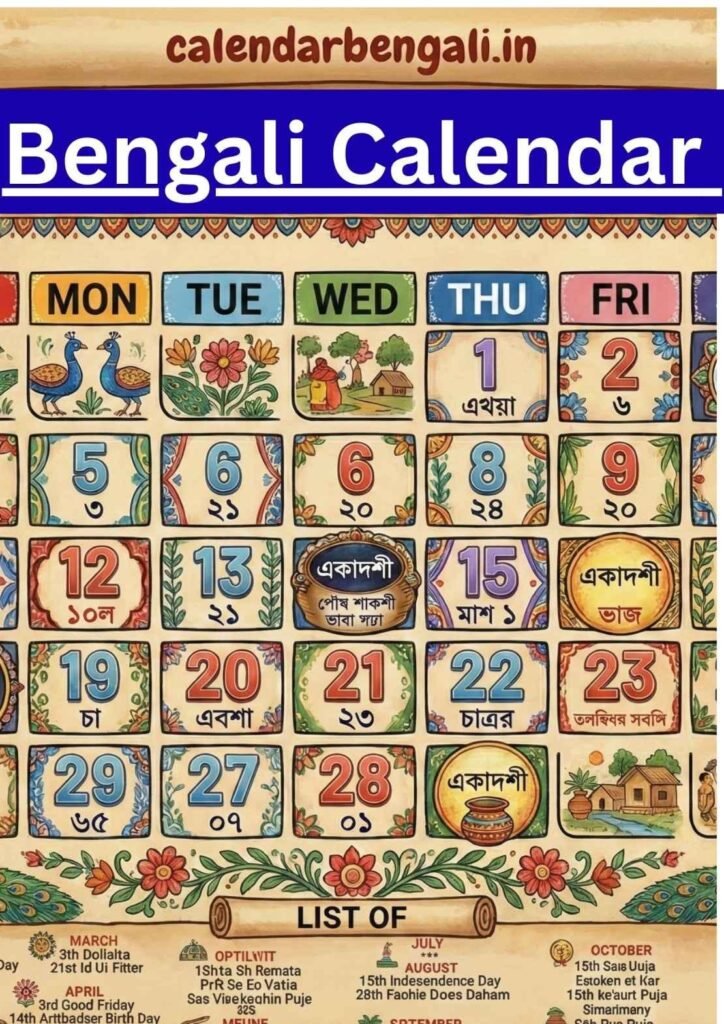
Bengali Calendar 2026 Holidays and Festivals — Complete Month-by-Month Table
I’ll organize all the information from the Bengali Calendar 2026 With Holidays into a comprehensive month-by-month table format:
| Month | Bengali Month | Key Festivals and Holidays |
|---|---|---|
| January 2026 | Poush – Magh | Makar Sankranti, Saraswati Puja, Netaji Jayanti, Republic Day |
| February 2026 | Magh – Falgun | Basant Panchami, Maha Shivaratri, Shab-e-Barat |
| March 2026 | Falgun – Chaitra | Dol Purnima (Holi), Ram Navami |
| April 2026 | Chaitra – Boishakh | Poila Boishakh 1433, Good Friday, Easter, Rabindra Jayanti |
| May 2026 | Boishakh – Jyaistha | Buddha Purnima, Rabindra Jayanti, Akshaya Tritiya |
| June 2026 | Jyaistha – Ashar | Snana Yatra, Rath Yatra |
| July 2026 | Ashar – Srabon | Guru Purnima, Devshayani Ekadashi |
| August 2026 | Srabon – Bhadra | Rakhi Purnima, Janmashtami, Independence Day |
| September 2026 | Bhadra – Ashwin | Vishwakarma Puja, Mahalaya, Pitru Paksha |
| October 2026 | Ashwin – Kartik | Durga Puja, Bijoya Dashami, Lakshmi Puja, Kali Puja |
| November 2026 | Kartik – Agrahayan | Kali Puja, Diwali, Bhai Phonta, Jagaddhatri Puja |
| December 2026 | Agrahayan – Poush | Poush Sankranti, Christmas |
Bengali Calendar 2026 — Detailed Month-by-Month Festival Guide
January 2026 — Poush and Magh (পৌষ – মাঘ)
January 2026 is a festive month in the Bengali calendar, covering the Bengali months of Poush 1432 and Magh 1432. The most important festival of this month is Makar Sankranti (Poush Sankranti), which falls on January 14, 2026. This harvest festival marks the transition of the Sun into the zodiac sign of Capricorn and is celebrated with traditional Pithe-Puli sweets, the Gangasagar Mela, and holy river baths across West Bengal.
Saraswati Puja, the beloved festival of the goddess of knowledge and learning, falls on January 23, 2026 (Vasant Panchami). Students and educational institutions across West Bengal and Bangladesh decorate pandals and pray to Goddess Saraswati for success in their studies and creative endeavors.
Other important days in January 2026 include Netaji Subhas Chandra Bose Jayanti (January 23), which is a state holiday in West Bengal, and Republic Day (January 26), which is a national holiday celebrated across all of India.
February 2026 — Magh and Falgun (মাঘ – ফাল্গুন)
February 2026 falls under the Bengali months of Magh 1432 and Falgun 1432. This month is associated with the arrival of spring and brings with it the energy of new beginnings. Maha Shivaratri is one of the key festivals of February 2026, dedicated to Lord Shiva. Devotees observe fasts, visit Shiva temples, and offer prayers throughout the night.
Basant Panchami (Vasant Panchami) brings vibrant yellow colors to Bengali life as people dress in yellow to welcome the spring season. Flute music, cultural events, and colorful processions mark this joyful occasion across West Bengal and Bangladesh.
March 2026 — Falgun and Chaitra (ফাল্গুন – চৈত্র)
March 2026 is celebrated with one of Bengal’s most colorful festivals — Dol Purnima, also known as Holi across India. Dol Purnima falls on March 4–5, 2026, and is celebrated with an explosion of colors, folk music, and traditional dances. In Shantiniketan, Dol Utsav is one of the most iconic spring celebrations in the world, with students and visitors participating in a glorious festival of music, dance, and natural colors.
Ram Navami, celebrated on March 27, 2026, marks the birth anniversary of Lord Rama and is observed with devotional songs, prayers, and processions across Hindu communities in West Bengal.
April 2026 — Chaitra and Boishakh (চৈত্র – বৈশাখ)
April 2026 brings the most eagerly awaited event in the Bengali calendar — Poila Boishakh, the Bengali New Year 1433, which falls on April 14 or 15, 2026. This is the single most celebrated occasion in Bengali culture. People dress in traditional attire, visit temples, attend cultural programs, enjoy Halkhata (new account books) rituals in markets, and celebrate with family and friends.
Rabindra Jayanti, the birth anniversary of Nobel Laureate poet Rabindranath Tagore, is celebrated with enormous cultural pride in April-May. Recitations of Tagore’s poems, songs (Rabindra Sangeet), and dance performances are organized across West Bengal, Shantiniketan, and Bengali communities worldwide.
May 2026 — Boishakh and Jyaistha (বৈশাখ – জ্যৈষ্ঠ)
May 2026 covers the Bengali months of Boishakh 1433 and Jyaistha 1433. Buddha Purnima (May 1, 2026) is an important festival of this month, celebrating the birth, enlightenment, and Mahaparinirvana of Gautama Buddha. Akshaya Tritiya, considered one of the most auspicious days of the year for new beginnings, purchases, and investments, also falls in May 2026.
June 2026 — Jyaistha and Ashar (জ্যৈষ্ঠ – আষাঢ়)
June 2026 is marked by two major Jagannath-related festivals. Snana Yatra, the sacred bathing ceremony of Lord Jagannath, is observed in early June. The grand Rath Yatra, or Chariot Festival, of Lord Jagannath falls on June 26, 2026, and is one of the largest religious processions in India. Devotees pull massive wooden chariots through the streets in a display of devotion, faith, and spiritual energy.
July 2026 — Ashar and Srabon (আষাঢ় – শ্রাবণ)
July 2026 is the monsoon month in the Bengali calendar. Guru Purnima (July 29, 2026) is a sacred occasion dedicated to honoring spiritual teachers, gurus, and mentors. Devshayani Ekadashi (July 25, 2026) marks the beginning of Chaturmas, the four-month period during which Lord Vishnu is believed to rest in cosmic slumber.
August 2026 — Srabon and Bhadra (শ্রাবণ – ভাদ্র)
August 2026 is one of the most festive months of the Bangla Calendar 2026. Rakhi Purnima (Raksha Bandhan) celebrates the beautiful bond between brothers and sisters, with sisters tying sacred threads on their brothers’ wrists. India’s Independence Day falls on August 15, 2026, a national holiday celebrated with patriotism across every corner of the country. Janmashtami, the birth anniversary of Lord Krishna, is also celebrated with midnight prayers, devotional songs, and Dahi Handi events.
September 2026 — Bhadra and Ashwin (ভাদ্র – আশ্বিন)
September 2026 brings the excitement of Durga Puja preparations. Vishwakarma Puja (September 17, 2026), dedicated to the divine architect and craftsman of the gods, is widely celebrated by workers, engineers, and artisans across West Bengal. Mahalaya, around October 2, 2026, marks the beginning of Devi Paksha and signals the countdown to the most awaited festival of Bengal — Durga Puja.
October 2026 — Ashwin and Kartik (আশ্বিন – কার্তিক)
October 2026 is the crown jewel of the Bengali Calendar 2026. Durga Puja, the grandest festival of Bengali culture, begins around Shashthi (approximately October 15) and culminates with Bijoya Dashami on October 20, 2026. For five glorious days, West Bengal transforms into a world-class open-air art exhibition, with thousands of elaborately decorated pandals, artistic idols, traditional music, and festive lights.
Immediately after Durga Puja, Lakshmi Puja (Kojagari Purnima) is observed on October 24, 2026. Bengalis worship Goddess Lakshmi with lotus flowers, offerings of fruit, and traditional sweets to invite prosperity and wealth into their homes.
November 2026 — Kartik and Agrahayan (কার্তিক – অগ্রহায়ণ)
November 2026 begins with another major festival — Kali Puja and Diwali on November 8, 2026. The new moon night of Kartik is illuminated by lamps, fireworks, and the worship of Goddess Kali, the fierce yet compassionate deity deeply revered in Bengal. Bhai Phonta (November 10, 2026) is a uniquely Bengali festival where sisters apply a sandal paste mark on their brothers’ foreheads and pray for their long life and well-being.
Jagaddhatri Puja (November 19, 2026) is celebrated with tremendous fervor, especially in Chandannagar and Krishnanagar in West Bengal, and is known for spectacular illuminated processions.
December 2026 — Agrahayan and Poush (অগ্রহায়ণ – পৌষ)
December 2026 is a time of quiet festivity and winter joy. Poush Sankranti preparations begin toward the end of the month. Christmas (December 25) is warmly celebrated in Kolkata, which has a long tradition of embracing Christmas as a multicultural celebration. Park Street in Kolkata is famous for its glittering Christmas decorations and festive atmosphere.
Ekadashi Dates in Bengali Calendar 2026
Observing Ekadashi (the 11th day of the lunar fortnight) is one of the most important spiritual practices for Hindu devotees. Here are the key Ekadashi dates in the Bengali Calendar 2026:
| Date | Ekadashi Name | Significance |
|---|---|---|
| January 13 | Shattila Ekadashi | Associated with prosperity and abundance |
| January 28 | Jaya Ekadashi | Brings victory and positive energy |
| February 12 | Vijaya Ekadashi | Observed for success and overcoming challenges |
| February 27 | Amalaki Ekadashi | Dedicated to the sacred Amla tree, highly auspicious |
| March 14 | Papamochani Ekadashi | Believed to cleanse sins and negative karma |
| March 28 | Kamada Ekadashi | Fulfills worldly and spiritual desires |
| June 25 | Nirjala Ekadashi | Most austere fast, observed without water |
| July 25 | Devshayani Ekadashi | Marks the beginning of Chaturmas |
| November 5 | Rama Ekadashi | Associated with Lord Rama, brings inner peace |
| November 20 | Devutthana Ekadashi | Marks the end of Chaturmas, Lord Vishnu awakens |
| December 20 | Mokshada Ekadashi | Believed to bestow liberation and spiritual freedom |
Note: Fasting for Ekadashi typically begins at sunrise and ends after sunrise the following day (Dwadashi). Please consult a local Panjika for exact timings based on your location.
Shubho Bibaho 2026 — Auspicious Marriage Dates in Bengali Calendar
Planning a Bengali wedding in 2026? Choosing the right auspicious Muhurat is one of the most important steps in Bengali wedding traditions. Based on the Bengali Calendar 2026 and Panjika guidelines, the following months and dates are considered favorable for Shubho Bibaho (শুভ বিবাহ):
Magh Month (January – February 2026)
The winter month of Magh is traditionally considered very auspicious for Bengali weddings. Favorable dates include January 16, 18, 23, 24, and 25, 2026. These dates fall during a period considered highly favorable for beginning new life chapters.
Falgun Month (February – March 2026)
The spring energy of Falgun brings good fortune for couples beginning their journey together. Auspicious dates include February 2, 4, 5, 12, 14, 16, and 26, 2026.
Baishakh Month (April – May 2026)
The Bengali New Year month of Baishakh, after Poila Boishakh, is a popular and auspicious choice for weddings. Dates like April 18, 20, 21, and 22, 2026 are widely selected by Bengali families.
Jyaistha Month (May – June 2026)
Early summer dates in Jyaistha can also be suitable for weddings. Consider June 1, 3, 5, 7, 11, and 15, 2026 as potential auspicious dates.
Agrahayan Month (November – December 2026)
The late autumn month of Agrahayan is another classic and widely preferred choice for Bengali weddings. Dates like November 20, 21, 23, 27, and 29, 2026 are typically considered auspicious.
Important Note: Always consult a qualified Bengali priest or Jyotishi (astrologer) to confirm the best Muhurat after matching the bride’s and groom’s birth charts (Janmakundali). The above dates are general guidelines from the Bengali Panjika 2026.
What is the Bengali Calendar?
The Bengali Calendar, also known as Bangla Calendar, Bongabda, or Bangla Panjika, is a traditional solar calendar that has guided Bengali people across West Bengal, Bangladesh, Tripura, Assam, and the global Bengali community for thousands of years. The Bengali calendar system is deeply embedded in the daily life, religious observances, cultural celebrations, and agricultural practices of Bengali people.
The current Bengali Calendar 2026 spans Bengali years 1432 and 1433. The Bengali year starts with the month of Boishakh (Baishakh), which begins in mid-April of the Gregorian year. The Bengali calendar consists of 12 months, each named after a specific star or nakshatra, and follows the solar cycle with great accuracy.
The Bengali Calendar 2026 is used to determine:
The exact dates of Hindu festivals and pujas. Auspicious timings (Shubho Muhurta) for weddings, naming ceremonies, house-warming events, and business openings. Fasting days including Ekadashi, Purnima, Amavasya, and Sankashti Chaturthi. Agricultural seasons and harvest celebrations. Cultural and literary anniversaries like Rabindra Jayanti and Nazrul Jayanti.
Frequently Asked Questions
Q1. What Bengali year is 2026?
The year 2026 corresponds to Bengali years 1432 and 1433 Bongabda. Bengali year 1432 runs from April 2025 to April 2026, and Bengali year 1433 begins with Poila Boishakh in April 2026.
Q2. When is Poila Boishakh in 2026?
Poila Boishakh, the Bengali New Year 1433, falls on April 14 or 15, 2026. This is the most celebrated occasion in the Bengali Calendar 2026.
Q3. When is Durga Puja in Bengali Calendar 2026?
Durga Puja 2026 will be celebrated in October. Mahalaya falls around October 2, 2026, and Bijoya Dashami (the final day of Durga Puja) falls on approximately October 20, 2026.
Q4. Is the Bengali Calendar 2026 PDF free to download?
Yes, the Bengali Calendar 2026 PDF is completely free to download. No registration, subscription, or payment is required.
Q5. Which months are best for Bengali weddings in 2026?
According to the Bengali Panjika 2026, the most auspicious months for Bengali weddings are Magh (January-February), Falgun (February-March), Baishakh (April-May), Jyaistha (May-June), and Agrahayan (November-December).
Q6. How many Ekadashi fasts are there in Bengali Calendar 2026?
There are 24 Ekadashi tithis in a full Bengali Calendar year (2 per lunar month). The most significant ones in 2026 include Nirjala Ekadashi (June 25), Devshayani Ekadashi (July 25), Devutthana Ekadashi (November 20), and Mokshada Ekadashi (December 20).
Conclusion
In this article, I have provided the complete Bengali Calendar 2026 with holidays, festivals, Ekadashi dates, auspicious marriage dates, and a full month-by-month guide. I have also explained all the important festivals of Bangla Calendar 2026 — from Makar Sankranti in January to Christmas in December — in a clear table format. Whether you are looking for West Bengal state holidays, national holidays, bank holidays, or religious festival dates, the Bengali Calendar 2026 covers everything you need for the entire year.